The Southern Truth: Kamala Harris Endorsement Powers Karen Bass’s Bid for a Second Term

Kamala Harris
 By Dr. Gloria Zuurveen, Editor-in-Chief
When a figure of the stature of Kamala Harris steps forward to endorse a sitting mayor, it is never just symbolic. It is a signal. A message. A line drawn in the political sand that says—this leadership matters, this moment matters, and this city cannot afford to turn back.
That is exactly what we are witnessing in the re-election campaign of Karen Bass.
Los Angeles is no small stage. It is a global metropolis—complex, layered, burdened with decades of systemic challenges that no single administration created, and no single administration can completely erase overnight. Homelessness, housing shortages, public safety concerns, and the ever-present tension between local governance and federal authority—these are not headlines, they are lived realities for the people of Los Angeles.
And yet, what we are seeing—whether one agrees with every decision or not—is movement backed by measurable results.
According to the campaign’s own reporting, street homelessness has declined by 17.5% under Mayor Bass—marking a reversal after years of steady increases. At the same time, her administration has accelerated more than 42,000 units of affordable housing, a number that speaks not to rhetoric, but to production in a city long criticized for building too little, too late. And in the area of public safety, Los Angeles has seen a drop in homicides to levels not recorded since the 1960s, alongside renewed efforts to rebuild LAPD hiring and expand community-based safety strategies.
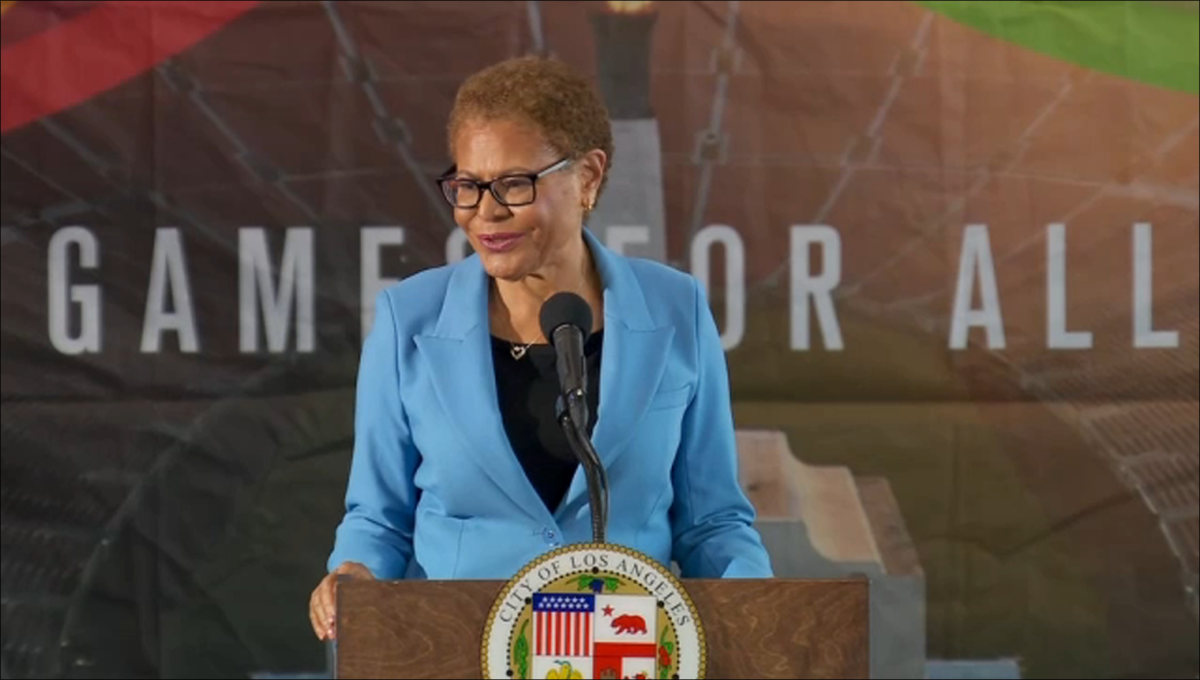
Los Angeles Mayor Karen Bass Photo credit: ABC7.com
Those are not abstract claims. Those are numbers being put forward as evidence of change.
The endorsement from Vice President Harris is rooted in that evidence. It reflects an alignment not only in values, but in outcomes—particularly when it comes to standing firm against federal pressures, including immigration enforcement policies associated with Immigration and Customs Enforcement.
But let’s tell the Southern Truth about what this really means.
Endorsements at this level are not given lightly. They are investments in continuity. Harris is not just supporting a candidate—she is supporting the idea that progress, however imperfect, should not be interrupted midstream. That the work of rebuilding a city as vast as Los Angeles requires time, consistency, and yes, political courage.
And courage is where Mayor Bass has carved her lane.
As the first Black woman to lead Los Angeles, her position is not just historic—it is scrutinized. Every move is measured. Every outcome is debated. That is the weight of representation in a city that has long struggled with equity, access, and trust in government.
But the question before voters is not whether everything has been fixed.
The question is this: Has there been enough forward motion—backed by real numbers—to justify continuation?

Mayor Karen Bass speaking during delegation meeting with Tom Perez and Neera Tanden, White House Director of Intergovernmental Affairs and White House Director of the Domestic Policy. Council
Because governing a city like Los Angeles is not about quick wins. It is about stamina. It is about understanding the machinery of government, the urgency of the streets, and the patience required to bring both into alignment.
Mayor Bass was not handed a clean slate. She inherited decades of deferred action, fragmented systems, and a housing crisis years in the making. What her administration has attempted to do is recalibrate how City Hall responds—faster on housing, more coordinated on homelessness, and broader in its approach to public safety.
Vice President Harris’s endorsement underscores a belief that this recalibration—now showing measurable signs like a 17.5% reduction in street homelessness, 42,000 housing units in motion, and historic declines in violent crime—is worth sustaining.
And here is the deeper truth—Los Angeles is at a crossroads where disruption for disruption’s sake can be just as dangerous as stagnation. Change must be measured not just by promises made, but by systems reshaped and outcomes that begin to bend, even slightly, in a different direction.
A “second chance” is not a reward.
It is a responsibility—on both sides.
For leadership, it means delivering more, faster, and with greater transparency.
For the people, it means staying engaged, holding power accountable, and doing their part in shaping the city they want to live in.
Because no mayor—no matter how capable—can transform Los Angeles alone.
The Southern Truth is this:
Power is not just in who endorses you.
It is in what you do with the time that endorsement—and the numbers behind it—buys you.
And in this moment, with the backing of one of the most powerful voices in American politics, Mayor Karen Bass has been given something invaluable in governance—
Time to continue the work.
Now the city will decide if that time has truly been earned.
Related Posts