THE SOUTHERN TRUTH Mayor Bass Cannot Afford to Ignore the Black Vote

By Dr. Gloria Zuurveen
The Los Angeles mayoral race has entered a new chapter.
The political spectacle surrounding Spencer Pratt has come to an end. As the ballots continue to be counted, the November runoff is now set between incumbent Mayor Karen Bass and Councilmember Nithya Raman. Recent election returns show Bass leading the field with roughly one-third of the vote while Raman overtook Pratt to secure second place in the runoff.
That result should concern City Hall.
Why?
Because the numbers suggest that a large majority of eligible voters did not participate in deciding who will lead America’s second-largest city.
The question is not simply who voted.
The bigger question is who stayed home.
And among those who stayed home are many Black voters who have not demonstrated the same enthusiasm that once helped propel Black candidates and Black political coalitions to victory throughout California.
History matters.
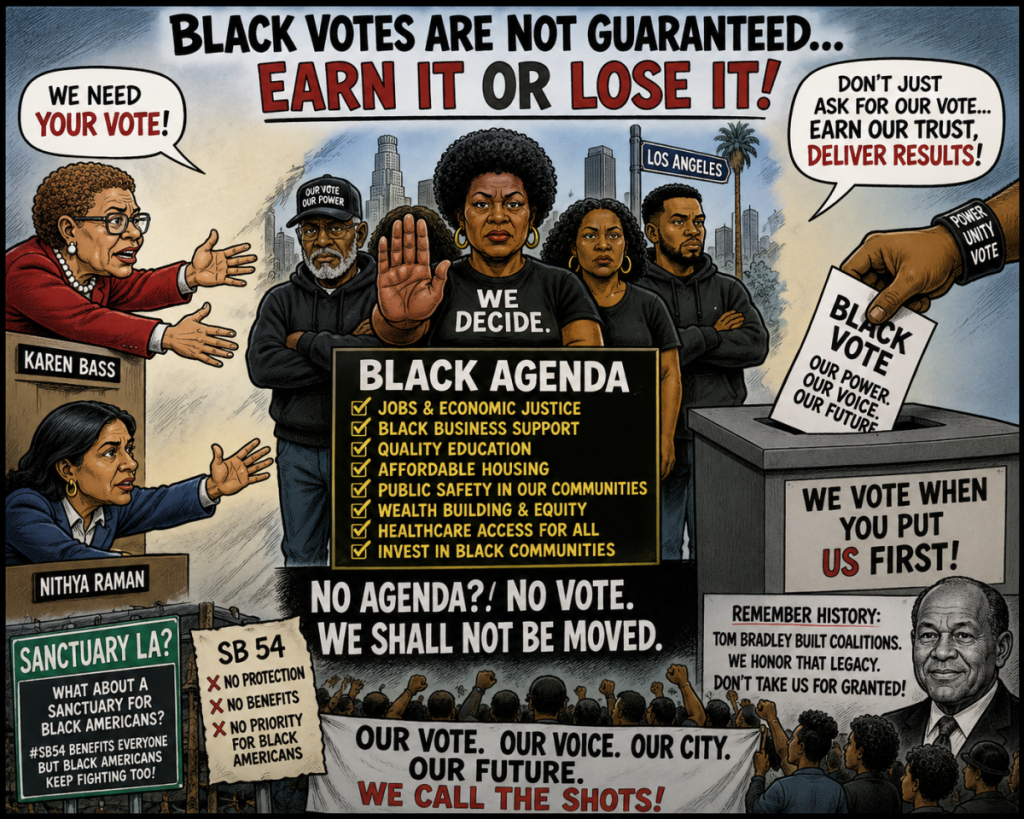
The late Tom Bradley built one of the most successful political coalitions in California history. He transformed Los Angeles and became one of the most respected mayors in America. Yet when he sought the governor’s office, many political analysts pointed to turnout patterns and coalition weaknesses as factors that contributed to his defeat.
Today, Mayor Bass faces a different election, but perhaps a similar political reality.
For years, many Black voters have remained among the most loyal supporters of Democratic candidates. Yet loyalty should never be confused with enthusiasm.
The concern being expressed in churches, community meetings, barber shops, beauty salons, neighborhood gatherings, and local media is increasingly straightforward:
“What is the Black agenda?”
Not a symbolic agenda.
Not a campaign-season agenda.
But a measurable agenda that addresses Black employment, Black business ownership, Black homeownership, Black educational outcomes, public safety, wealth creation, workforce development, and economic mobility. That question becomes even more significant when discussing California’s sanctuary policies.
Senate Bill 54, authored by former State Senator Kevin de León and signed into law in 2017, limits the use of state and local law-enforcement resources for federal immigration enforcement. The law, commonly called the California Values Act or “Sanctuary State” law, remains one of the most significant public policy decisions in modern California politics.
Supporters argue SB 54 protects immigrant families, encourages cooperation with local law enforcement, and keeps schools, hospitals, libraries, and public institutions accessible.
Critics, however, continue to ask another question:
Where is the equivalent legislative urgency for Black Californians?
Many Black residents point to rising unemployment, housing displacement, business closures, declining homeownership rates, and growing economic inequality as evidence that the state has not developed an equally visible and measurable policy agenda focused specifically on the advancement of Black Californians.
Whether one agrees with that criticism or not, it is a conversation that continues to grow louder.
And that conversation brings us to one of the most influential figures operating behind the scenes in Los Angeles politics.
Kerman Maddox did not become influential overnight.
Maddox rose through political, business, and communications circles as an entrepreneur and strategist. Today he serves as Managing Partner of Dakota Communications and has become one of Southern California’s most recognizable political operatives. He served as a senior strategic advisor and finance chair for Karen Bass’s mayoral campaign and has been credited with helping secure endorsements, coordinate faith-based outreach, organize community engagement efforts, and manage ethnic-media communications. Following Bass’s election, he also served on her transition team.
No one can seriously argue that Kerman Maddox lacks influence.
The question is whether that influence is being effectively used to re-energize Black voters who increasingly feel disconnected from City Hall.
The challenge facing the Bass campaign is not merely defeating Raman.
The challenge is rebuilding enthusiasm.
Because elections are not won simply by endorsements.
They are not won simply by fundraising.
They are not won simply by press conferences.
They are won by voters.
And when voters choose not to participate, that absence becomes its own political statement.
November will not be decided by Spencer Pratt.
It will not be decided by social media headlines.
It may very well be decided by whether thousands of Black voters who sat out the primary election decide they have a reason to return to the ballot box.
That is the challenge.
That is the opportunity.
And that is the question Mayor Bass and her advisors must answer between now and November:
Have they truly heard what many Black voters have been saying?
Or are they taking the Black vote for granted?
The voters themselves will provide the answer.
And that answer will arrive on Election Day.
That is The Southern Truth.