The Spirit of Slavery Still Walks Among Us
What John Hope Franklin Warned Us About — and What We Are Witnessing Today
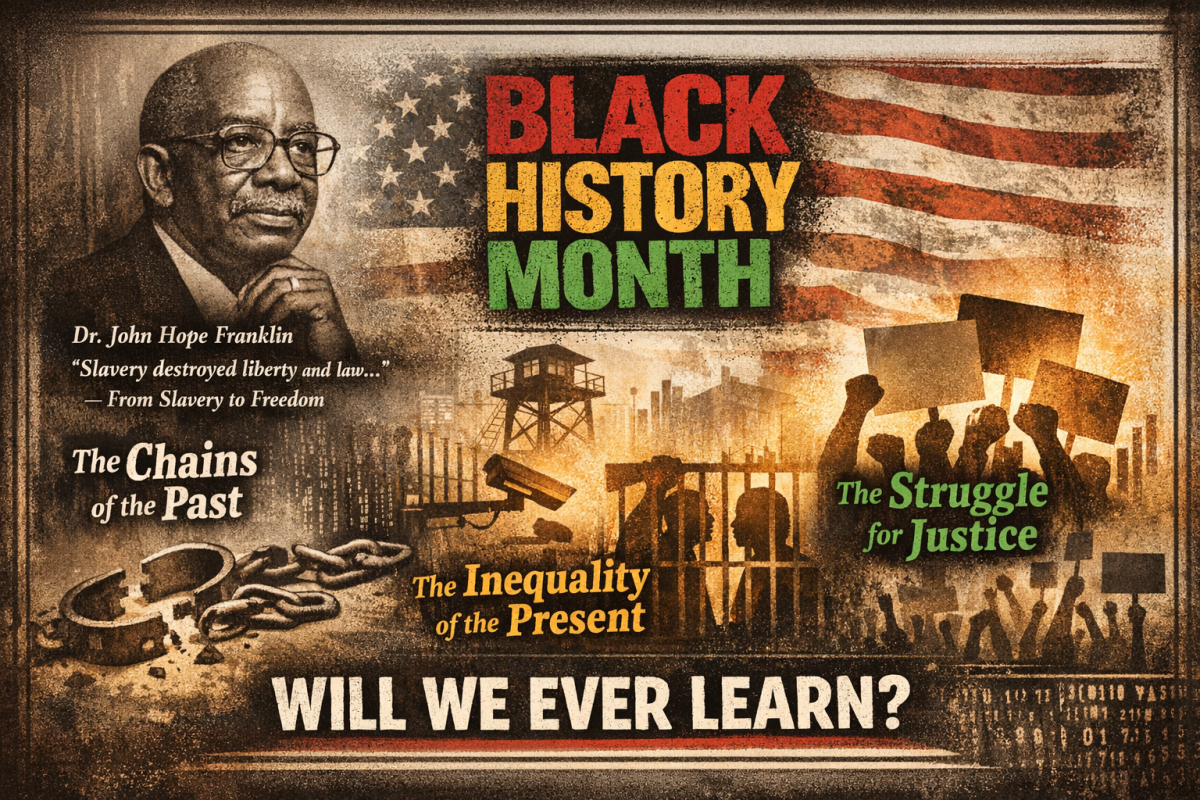
 By Dr. Gloria Zuurveen, Editor-in-Chief
As Black History Month approaches, it is important that we do more than recite names, dates, and ceremonial victories.
Black history is not a museum exhibit. It is a living record — one that speaks, warns, and testifies. Few historians captured that truth more clearly than Dr. John Hope Franklin, whose seminal work From Slavery to Freedom: A History of African Americans remains one of the most important and enduring chronicles of Black life in America. First published in 1947 and revised across generations, the book does not romanticize the past. Instead, it exposes the moral contradictions of a nation built on liberty while practicing human bondage. Franklin was careful, precise, and scholarly — but his conclusions were unmistakable.
He argued that slavery did not merely exploit Black people; it corrupted the moral foundation of the South itself. In his analysis, slavery “destroyed liberty and law” and vitiated the very white institutions that claimed to uphold civilization. The system did not simply brutalize enslaved Africans — it reshaped white society into something dependent on coercion, fear, and racial hierarchy to survive. That distinction matters. Slavery, Franklin taught us, was not just a labor system.
It was a state of mind.
The Southern Paradox: Law Without Justice
In From Slavery to Freedom, Franklin explains that slavery required the erosion of legal norms. Laws had to be bent or rewritten to justify human ownership. Courts became instruments of control rather than justice. Violence became normalized — not as criminal behavior, but as social order. He wrote plainly that the South’s attachment to slavery weakened its respect for law itself, making it impossible to build a truly democratic society while bondage remained its economic engine. This is why Reconstruction failed. Not because formerly enslaved people were “unprepared,” as later myths suggested — but because the moral and political infrastructure of the South had been so thoroughly damaged by slavery that it resisted equality at every turn. The system had trained generations to believe that freedom for Black people meant loss for whites. That belief did not disappear in 1865.
It evolved.
The Modern Echo: Slavery Without Chains
Today, we are witnessing something disturbingly familiar — not slavery in its 19th-century form, but what can only be described as its digital and bureaucratic descendant.
The mechanisms have changed:
- Surveillance instead of overseers
- Algorithms instead of plantation ledgers
- Policing and incarceration instead of patrols
- Economic exclusion instead of slave codes
- Voter suppression instead of literacy tests
But the underlying logic remains recognizable.
Who is deemed deserving?
Who is presumed guilty?
Who receives protection, and who receives punishment?
Franklin warned that when a society normalizes inequality long enough, it begins to defend it as tradition, patriotism, or “law and order.” That warning echoes loudly today in rhetoric that frames entire communities as threats, burdens, or outsiders — even when they are native-born Americans.
“Make America Great Again” — For Whom?
This moment in American history raises a question Franklin implicitly asked decades ago: What version of America are we trying to restore?
Because the version many seem to long for is one where:
- Rights were unevenly distributed
- Labor was exploited without protection
- Protest was criminalized
- Citizenship was conditional
- Power flowed in only one direction
That nostalgia is not accidental. It is rooted in the same cultural memory that once defended slavery as “necessary,” segregation as “orderly,” and exclusion as “tradition.” Franklin dismantled those myths with evidence, not emotion. He showed that the South’s insistence on preserving racial hierarchy ultimately delayed its economic growth, weakened its institutions, and poisoned its civic life. The tragedy was not just what slavery did to Black people — but what it did to the nation’s moral compass.
A Warning, Not a Lament
John Hope Franklin did not write From Slavery to Freedom as a lament.
He wrote it as a warning and a roadmap. He believed that democracy required:
- An honest accounting of history
- Equal protection under the law
- Education grounded in truth
- And the courage to confront injustice, even when it is popular
Black History Month, then, is not about celebration alone. It is about vigilance. Because the “spirit of slavery” does not announce itself with chains and auctions anymore. It appears in policy decisions, digital surveillance, economic displacement, mass incarceration, and the quiet normalization of inequality. And just as Franklin documented, when injustice becomes routine, society stops seeing it as injustice at all.
The Question Before Us
The question before America today is the same one Franklin posed through his scholarship:
Will we continue to rebuild systems that reflect the worst instincts of our past — or finally honor the democratic promise we have long claimed to represent?
History has already given us the answer to what happens when we choose wrong.
The only question left is whether we are willing to listen.
SOURCE
Franklin, John Hope.
From Slavery to Freedom: A History of African Americans.
McGraw-Hill Education.