THE SOUTHERN TRUTH Black Political Strength Holds Across California, But Will Black Issues Finally Take Center Stage?
 By Dr. Gloria Zuurveen, Editor-in-Chief
As California continues counting ballots from the June 2 Primary Election, reporting compiled by veteran journalist Joe W. Bowers Jr. of California Black Media reveals that Black candidates across the state are once again demonstrating political resilience and electoral strength. According to Bowers’ statewide analysis, Black incumbents and challengers alike are positioned to maintain a significant presence on the November ballot, underscoring the continuing influence of Black voters in shaping California’s political landscape.
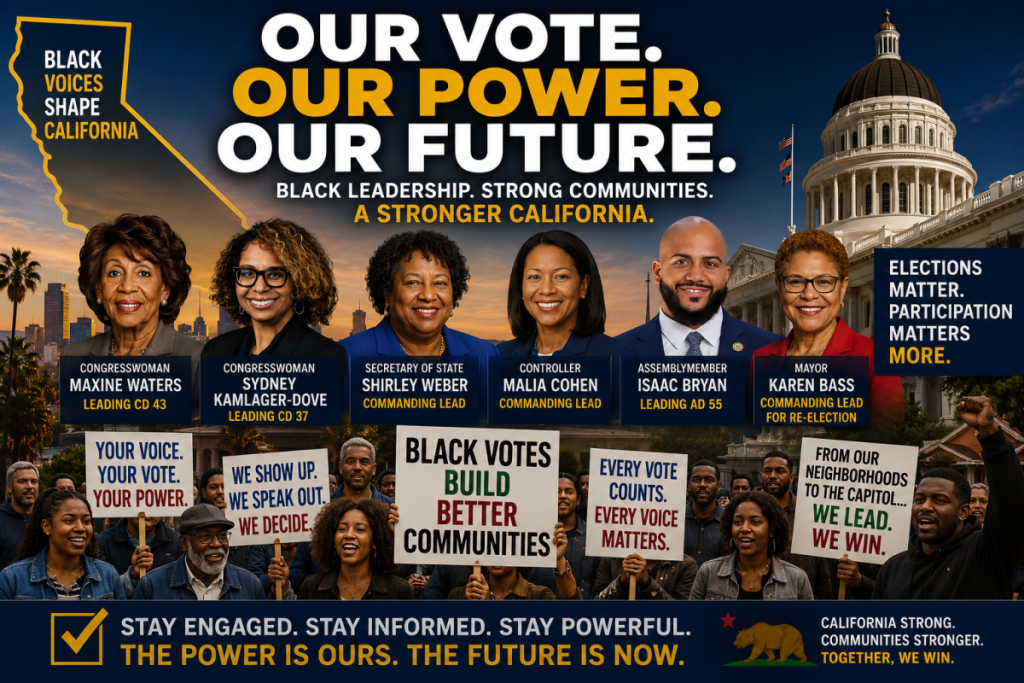
While some high-profile contests remain too close to call, the overall picture emerging from the election returns suggests that Black political representation remains firmly embedded throughout California’s congressional, legislative, and constitutional offices. Congresswoman Maxine Waters once again led the field in Congressional District 43. Congresswoman Sydney Kamlager-Dove remains in a strong position in Congressional District 37. Secretary of State Shirley Weber and State Controller Malia Cohen continue to demonstrate the strength of their statewide support. Across California, Black elected officials have largely maintained their political footing and continue to command substantial voter confidence. According to California Black Media’s election reporting, former Stockton Mayor Michael Tubbs and former State Senator Steven Bradford face more difficult paths forward, while Governor’s candidates Xavier Becerra, Steve Hilton, and Tom Steyer continue to battle for position as ballots are counted and analyzed.
But beyond who wins and who loses, there is a larger question confronting Black California. What exactly are Black voters receiving in return for their loyalty?
For decades, Black voters have consistently turned out at some of the highest rates for Democratic candidates. They have organized, volunteered, donated, marched, and mobilized communities. Black elected officials have achieved remarkable victories throughout California. Yet many Black communities continue to face disproportionate rates of homelessness, underperforming schools, declining homeownership, business disinvestment, over-policing, under-representation in contracting, and widening wealth disparities.
The Southern Truth believes that the November election should mark the beginning of a new conversation.
The conversation is not merely about electing Black candidates.
The conversation is about advancing Black interests.
As candidates prepare for the November General Election, they should expect a new level of accountability from Black voters and Black organizations throughout California. A growing coalition of Black organizations, community leaders, churches, business owners, educators, journalists, and advocates is expected to call upon candidates seeking Black support to publicly review and respond to a proposed Black Agenda before Election Day. The principle behind this request is not new.
Former State Senate President Pro Tempore Kevin de León successfully championed Senate Bill 54, legislation that established California as a Sanctuary State. That law was designed to provide protections for a specifically identified population that lawmakers believed required protection from harmful governmental actions.
Whether one agrees or disagrees with SB 54, the legislation demonstrated an important political reality: when a community organizes around common interests and demands public policy protections, elected officials often respond.
Older Black Californians remember another lesson from political history that should not be ignored.
The late Los Angeles Mayor Tom Bradley, one of California’s most accomplished political figures, sought the governorship with what many believed was a broad coalition of support. Yet despite his popularity and statewide recognition, Bradley ultimately fell short in his bid for Governor. Political analysts have debated the reasons for decades, but among many Black community leaders there remains a persistent belief that portions of the Black community felt increasingly disconnected from the benefits of political success and, as a result, did not fully exercise their collective power at the ballot box.
Whether one accepts that interpretation entirely or not, the lesson remains relevant today. Political power is not permanent. It must be maintained through engagement, accountability, and a clear understanding between elected officials and the communities that help put them in office.
The Southern Truth believes that history offers a warning for every candidate seeking office in November. No elected official should assume that Black votes are automatic. No candidate should assume that historical loyalty guarantees future support. Communities that feel excluded from economic opportunity, policy priorities, government contracts, quality education, homeownership opportunities, and wealth-building initiatives may eventually decide to withhold the very power that helped elect those officials in the first place.
The ballot box remains one of the few places where ordinary citizens possess the same power as the wealthy, the connected, and the politically influential. When exercised collectively, that power can determine who wins, who loses, and what issues receive attention.
That is why the emerging call for a Black Agenda is about more than politics. It is about ensuring that Black communities are not merely represented in campaign photographs and election speeches, but are meaningfully included in the policies, investments, and opportunities that follow after Election Day.
The question now being raised by many Black Californians is simple.
If California can establish protections for one community through public policy, why can there not also be a comprehensive policy agenda designed to address the ongoing conditions disproportionately impacting Black Californians?
That conversation is likely to become increasingly prominent between now and November.
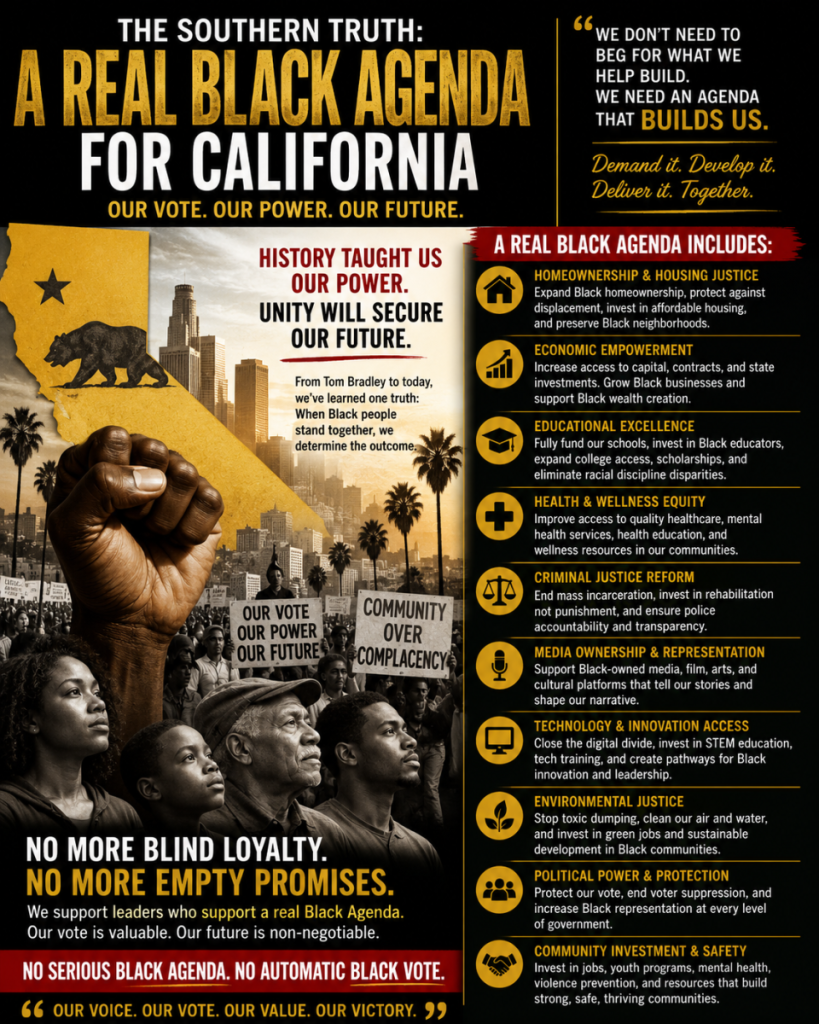
The proposed Black Agenda would focus on measurable outcomes in education, homeownership, economic development, workforce participation, public contracting, public safety, criminal justice reform, health equity, reparative policies, media ownership, and protections against discriminatory practices that continue to negatively impact Black communities.
Candidates seeking support from Black voters may soon be asked a straightforward question:
Will you publicly support a Black Agenda?
Not as a campaign slogan.
Not as an election-year promise.
But as a governing commitment.
Black elected officials, Black candidates, and non-Black candidates alike should understand that this conversation is not intended to divide Californians. Rather, it is intended to address longstanding inequities that have too often been acknowledged but rarely resolved.
The Southern Truth has long maintained that voting remains one of the most powerful tools available to the people.
However, voting alone is not enough.
Policy matters.
Accountability matters.
Results matter.
The June Primary Election has demonstrated that Black political influence remains alive and well throughout California.
The challenge now is determining whether that influence will be translated into policies that directly benefit Black communities.
The election results show that Black candidates continue to win seats.
The next question is whether Black communities will win meaningful change.
That may become the defining political question between now and November.
And candidates seeking votes would be wise to begin preparing their answers.