
The Southern Truth: What Was Won-And What Is Now At Risk
An Urgent Reckoning in the Wake of the Court
 By Dr. Gloria Zuurveen, Editor-in-Chief
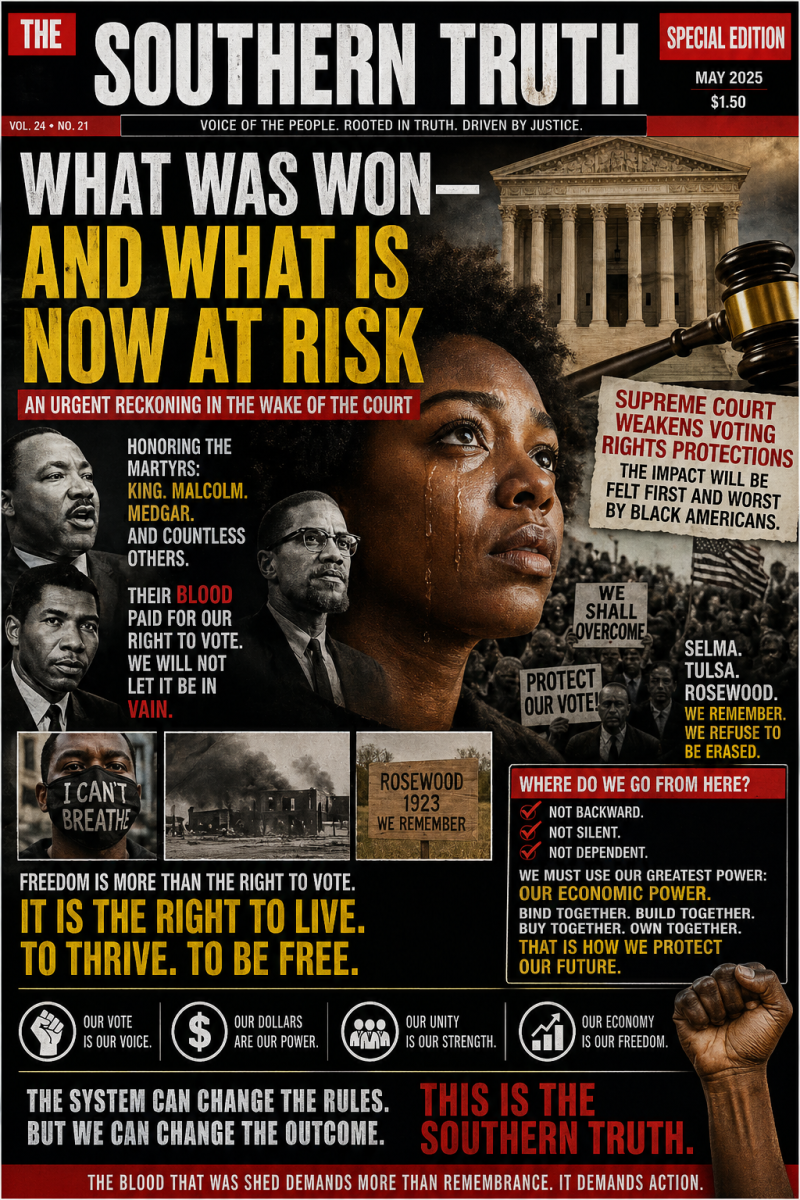
The fight for voting equality was one of the most brutal and defining struggles of the civil rights movement. Before the passage of federal protections, Black Americans were fired from their jobs, driven from their homes, beaten, and even killed simply for attempting to vote.
Killed—like so many Black martyrs whose names are etched into the conscience of this nation: Martin Luther King Jr., Malcolm X, and Medgar Evers—and the countless others whose stories never made headlines.
And even in modern times, the echoes remain—voices cut short, like Eric Garner, whose final words, “I can’t breathe,” became a cry heard around the world. Not to mention entire Black communities—prosperous, self-sustaining—destroyed by violence and hate, such as Tulsa Race Massacre and Rosewood Massacre. The blood that was shed was not only for civil rights—it was for freedom itself, for the right to exist as full human beings in a land where we had long been denied that truth.
But history demands that we ask an uncomfortable question: What did those victories ultimately deliver?
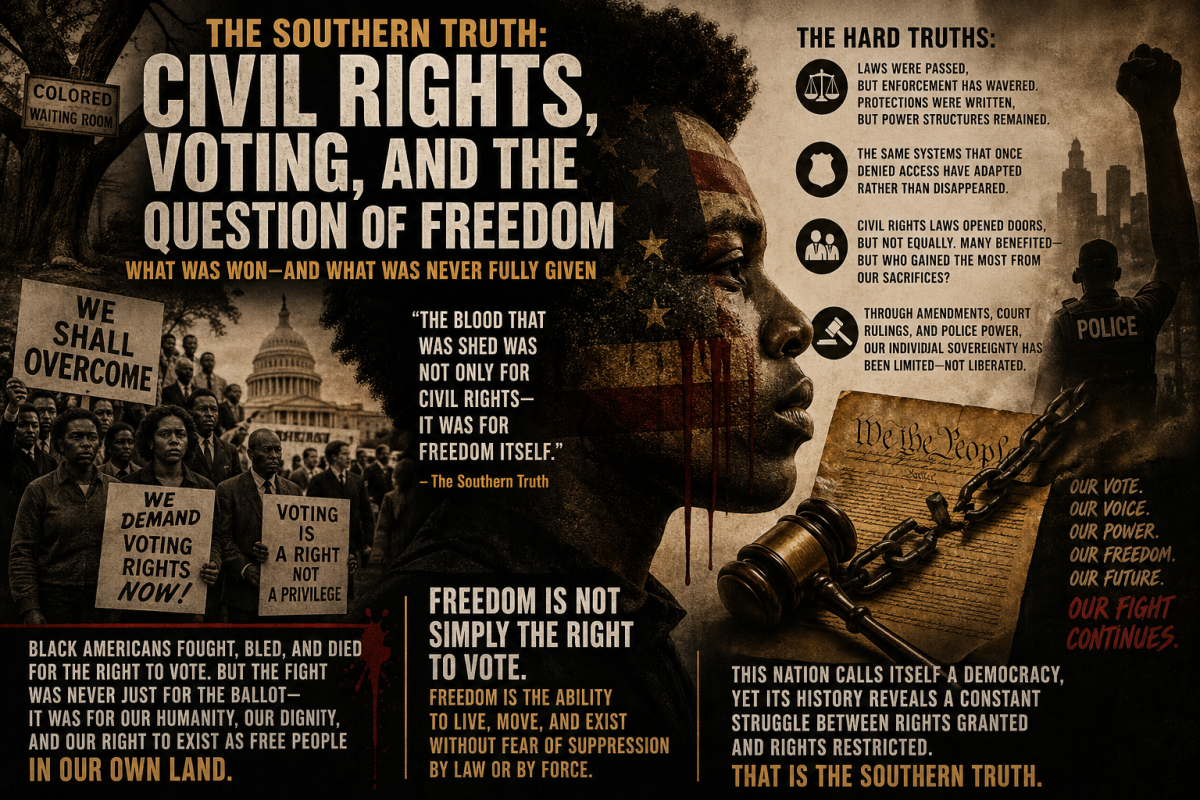
The promise of voting rights was framed as liberation. Yet the reality has been far more complex. Laws were passed, but enforcement has wavered. Protections were written, but power structures remained. The same systems that once denied access have, in many ways, adapted rather than disappeared.
And now, in this moment, we are witnessing something that cannot be ignored.
Recent decisions from the U.S. Supreme Court have narrowed key protections once used to defend Black voters—particularly those rooted in the legacy of the Voting Rights Act of 1965. Not erased—but weakened. Not destroyed—but made more difficult to enforce.
The law still stands.
But the question is—how strong is it?
There is a growing truth many are beginning to confront—civil rights did not necessarily produce full sovereignty. Instead, it created access within a system that still holds the authority to regulate, restrict, and, at times, suppress through policy, policing, and institutional control.
And while those hard-fought laws opened doors, they did not open them equally. Civil rights legislation expanded protections that would later benefit many groups, raising a difficult but necessary question: who has ultimately gained the most from sacrifices made during the Black freedom struggle?
This is not to diminish the movement—but to examine its outcome with clear eyes.
Because freedom is not simply the right to vote.
Freedom is not participation alone.
Freedom is the ability to live, move, and exist without fear of suppression—by law or by force.
The United States presents itself as a democracy, yet its history tells a more complicated story—one where rights have been granted and restricted in the same breath. Through amendments, court rulings, and the expansion of state power, individual sovereignty has often been shaped by those who govern, rather than those who live under that governance.
And so now, the moment we are in demands more than reflection.
It demands response.
Because if protections can be narrowed,
If enforcement can be weakened,
If access can once again be contested—
Then the burden returns to the people.
And the Southern Truth must say what others hesitate to declare:
Black Americans—whose blood secured these rights—will feel the weight of that shift first and most.
So where do we go from here?
Not backward.
Not silent.
Not dependent solely on systems that have shown their limits.
We go forward with understanding that political power without economic power is fragile.
We go forward by binding together—intentionally, strategically, unapologetically—using our dollars, our institutions, and our collective influence to reinforce what the law alone has not guaranteed.
Because history has already shown us:
Rights can be written.
They can be challenged.
They can be narrowed.
But power—when unified—can protect what paper cannot.
This is the wake-up call.
Not just to vote.
But to build.
To sustain.
To control the economic engines that shape communities and outcomes.
Because if the system can shift—
Then the strategy must shift too.
The blood that was shed demands more than remembrance.
It demands evolution.
So the question is no longer just what was won.
The question is—
What are we prepared to protect now?
That is not rhetoric.
That is not revision.
That is the Southern Truth.
Dear Gloria,
What you doo by keeping us informed and updated in more critical now than ever before, as this administration not only has political and legal power, but military forces it has unleashed on the people of this country without hesitation. I have some DEI issues I will share with you later, but I must share this post with others now, and encourage them to subscribe.