THE SOUTHERN TRUTH: The Legacy They Inherited — and the Responsibility They Now Avoid
 The Southern Truth
By Dr. Gloria Zuurveen, Editor-in-Chief
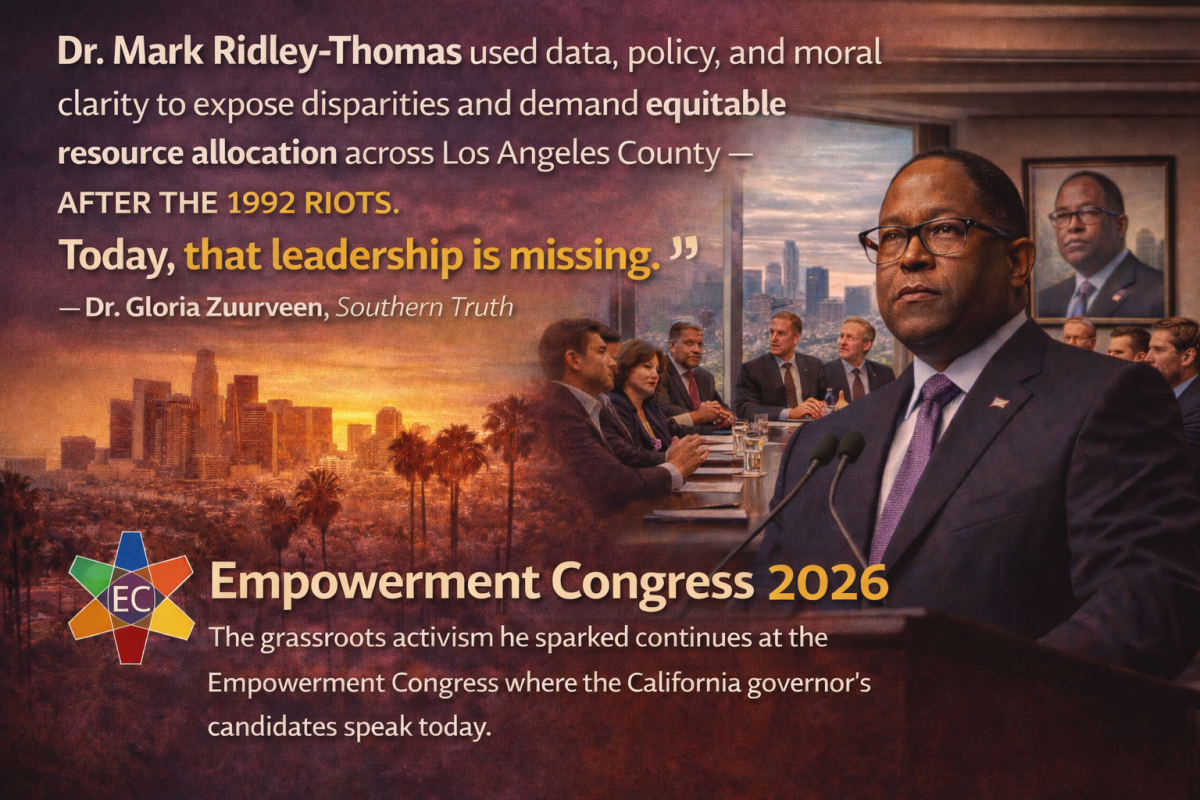
This silence is especially troubling given the legacy of leaders like Dr. Mark Ridley-Thomas, who understood that justice does not occur by accident — it must be designed, defended, and demanded. Long before “equity” became a political buzzword, Ridley-Thomas used data, policy, and moral clarity to expose the deep disparities embedded within Los Angeles County. Even in the aftermath of Proposition 209, when race-based remedies were politically constrained, he found lawful, strategic ways to demonstrate how resources were being distributed inequitably — and he challenged the system to correct itself. He understood what too many leaders today refuse to acknowledge: equity requires intention.
That understanding led him, in 1992, to convene the first Empowerment Congress, shortly after being elected to the Los Angeles City Council and in the wake of the Rodney King beating. The city was fractured. Trust in government was broken. Communities were demanding voice, not symbolism.
The Empowerment Congress was not created as a political stage — it was built as a civic mechanism. A way for neighborhoods to engage government directly, to shape policy from the ground up, and to ensure that residents were not merely represented, but heard. It became the blueprint for what would later evolve into Los Angeles’ Neighborhood Council system — a model of participatory democracy studied nationwide.

That legacy matters today.
Because the very stage where gubernatorial candidates now stand — speaking of solutions, unity, and progress — exists in large part because Ridley-Thomas insisted that communities most impacted by inequality must have a seat at the table.
And yet, today, the conversation has drifted.
We hear speeches about homelessness without an honest examination of why Black Angelenos remain disproportionately unhoused. We hear commitments to innovation while automation and artificial intelligence threaten to deepen economic displacement. We hear promises of inclusion while the structural conditions that produce exclusion remain untouched.
Dr. King warned against this kind of leadership — leadership that soothes rather than solves, that gestures rather than governs. In Strength to Love, he cautioned against the comfort of conformity and called instead for moral courage rooted in truth.
Mark Ridley-Thomas carried that ethic forward in policy form.
He understood that progress without equity is illusion. That data without action is negligence. That justice delayed is not neutral — it is harmful.
Today, as candidates gather once again at the Empowerment Congress, the question before them is not whether they can speak eloquently. It is whether they will honor the purpose of the space they occupy.
Will they confront the uncomfortable truths about racial inequity?
Will they commit to intentional investment, not symbolic inclusion?
Will they recognize that Black Californians are not a voting bloc to be courted, but a people whose labor, leadership, and sacrifice helped build this state?
Because this moment demands more than applause lines.
It demands the courage to finish the work that Dr. King envisioned — and that Mark Ridley-Thomas labored to institutionalize.
Anything less is not leadership.
It is avoidance.