
Boycott Walmart: From Mr. Cap Casey’s Store to Corporate Surveillance, Senatobia Demands Answers

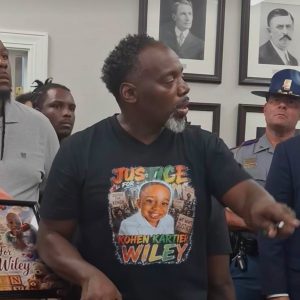
Kohen Wiley allegedly killed by Senatobia police Hunter Foster on Sunday, June 14, 2026 in Walmart parking after an alleged shoplifting call to Senatobia police department. Courtesy photo from Darronte Lofton’s facebook page.
The Southern Truth
 By Dr. Gloria Zuurveen, Editor-in-Chief
Dear Reader,
I grew up in Senatobia when things were different.
Long before Walmart.
Long before artificial intelligence.
Long before sensors, algorithms, predictive analytics, and what corporations now call “operational efficiency.”
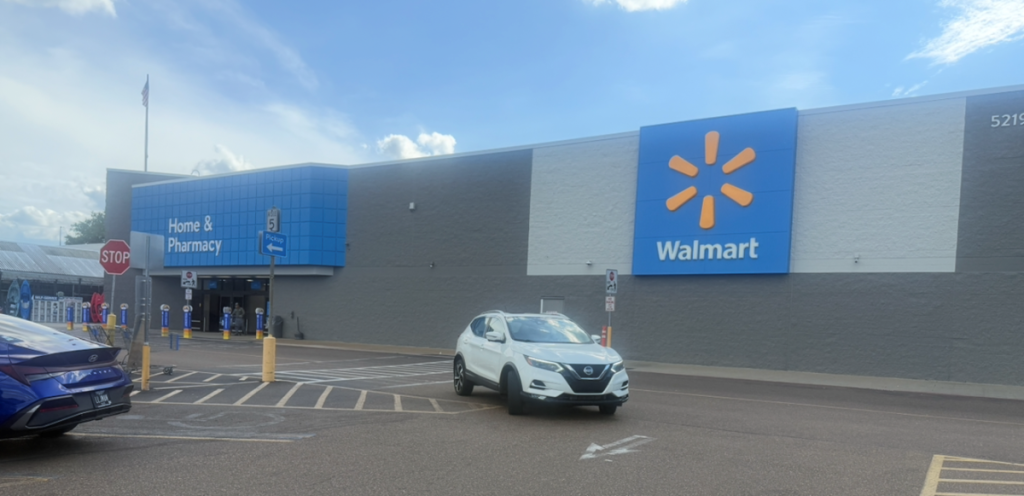
Front of Walmart in Senatobia on 51 Highway where Kohen Wiley was shot by a Senatobia policeman Hunter Foster. Photo by Gloria Zuurveen
Back then, we had stores like Mr. Cap Casey’s. Around the corner was Mr. Polly Davis’s store. Down the road was Mr. Jeanie Mae’s store. Next door was Aunt Juanita, whom many still know today as the Candy Lady at 95 years old. People came and went every day in the old neighborhood near what would later become the housing projects. Before the projects were built, the area was mostly pastureland where cattle roamed, with only an occasional shack scattered here and there.
Then one day, Ms. George Anna and her large family, including her daughter Louise, who had a child with Melvin—my cousin and Aunt Juanita’s son—took up residence and made it a home. From that family came Linda, who would go on to become the first Black bank clerk in Senatobia.
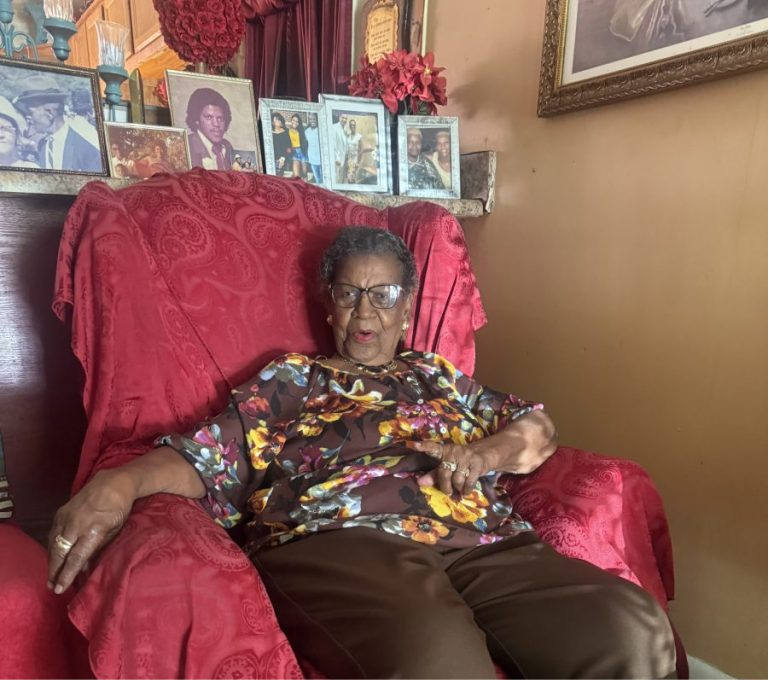
Aunt Juanita Walker Ross, 95. Photo by Gloria Zuurveen
We knew each other.
We trusted each other.
Sometimes people bought groceries on credit.
Sometimes purchases were written “on the book.”
Sometimes there wasn’t even a name.
Sometimes it was just an “X” because some folks couldn’t read or write.
Yet business still got done.
The children got fed.
Families survived.
People bartered.
People traded.
People paid when they could.
And somehow, despite all the technology that supposedly makes life better, our communities functioned just fine.
What we had then was something technology still cannot manufacture.
Trust.
Community.
Relationships.
Accountability.
Today, all of that is being replaced by data.

Walmart, the largest retailer in America, is now deploying millions of battery-free Ambient IoT sensors across its operations. Through a partnership with technology company Wiliot, the corporation plans to scale the technology throughout approximately 4,600 stores and more than 40 distribution centers nationwide.
The company says the goal is efficiency.
The technology companies call it innovation.
The public is told it improves inventory management.
The public is told it helps track merchandise.
The public is told it reduces food waste.
The public is told it improves supply-chain visibility.
Those things may all be true.
But before we accept those explanations at face value, perhaps we ought to ask a more important question.
What exactly does “operational efficiency” mean?
History teaches us to be careful whenever powerful institutions use pleasant language to describe systems that affect ordinary people.
The plantation owners of the Antebellum South called slavery an economic necessity.
Industrial barons called child labor productive.
Segregationists called separate schools orderly.
Today, corporate America calls unprecedented levels of tracking, monitoring, artificial intelligence, and data collection operational efficiency.
The words change.
The power remains.
Now before anyone misunderstands the point, this is not to compare modern retail technology to slavery.
It is to remind us that throughout history, those in power have often used respectable language to justify systems that ordinary people might question if they fully understood them.
That is why transparency matters.
That is why the people have a right to know.
Because when technology designed to watch products begins influencing decisions about people, the conversation changes.
At what point does asset protection become surveillance?
At what point does a computer-generated alert become suspicion?
At what point does suspicion become intervention?
At what point does intervention become confrontation?
And at what point does confrontation become tragedy?
These are not academic questions.
These are real questions.
And they matter in small Southern towns like Senatobia.
Most people walking into Walmart on Highway 51 are thinking about groceries.
They are thinking about school supplies.
They are thinking about paying bills.
They are thinking about making it through another week.
Most have never heard the phrase Ambient IoT.
Most do not know that Walmart is investing heavily in systems capable of tracking millions of pallets, collecting real-time information, feeding artificial intelligence systems, and generating data on an unprecedented scale.
Most simply do not know.
And that is the issue.
Not necessarily the technology.
The lack of public awareness.
The lack of transparency.
The lack of informed understanding.
The people have a right to know what systems are operating around them.
The people have a right to know how decisions are made.
The people have a right to know how information is gathered, stored, shared, and used.
The people have a right to ask questions without being labeled anti-business or anti-technology.
That is not fear.
That is citizenship.
That is democracy.
And here in Senatobia, people are asking questions.
The death of young Kohen Wiley has left a community grieving and searching for answers.
The Mississippi Bureau of Investigation must continue its work and follow the facts wherever they lead.
The facts matter.
The truth matters.
The investigation matters.
But while investigators search for answers regarding one tragedy, citizens have every right to ask larger questions about the systems that increasingly shape daily life.
What technologies are being used?
What information is collected?
Who has access to it?
How long is it stored?
How does artificial intelligence influence decisions made by employees, managers, security personnel, and law enforcement?
What safeguards exist when systems are wrong?
Because every corporation promises efficiency.
Every technology company promises innovation.
Every system promises accuracy.
Yet human beings remain imperfect.
Algorithms can be wrong.
Data can be incomplete.
Assumptions can be flawed.
And when mistakes happen, it is usually not the corporation that pays the highest price.
It is the customer.
It is the family.
It is the community.
That is why the boycott being discussed throughout Senatobia is important to understand.
A boycott is not violence.
A boycott is not chaos.
A boycott is communication.
A boycott is how ordinary people get the attention of institutions that otherwise might not listen.
A boycott says:
“Come sit down at the table.”
“Talk to us.”
“Respect us.”
“Answer our questions.”
“Treat us like stakeholders and not merely consumers.”
And if Walmart is listening, there is something they should understand about Senatobia.
This is not a place where people live disconnected from one another.
We have kinfolk.
We have church family.
We have classmates.
We have cousins.
We have generations connected through blood, friendship, and shared history.
When one family hurts, another family feels it.
When one family mourns, another family mourns with them.
And when the Black community of Senatobia speaks collectively, it should not be ignored.
Because Black dollars matter.
Black consumers matter.
Black families matter.
And in a town like Senatobia, when you affect one household, chances are you affect many others connected to it.
That is not a threat.
That is the reality of a Southern town.
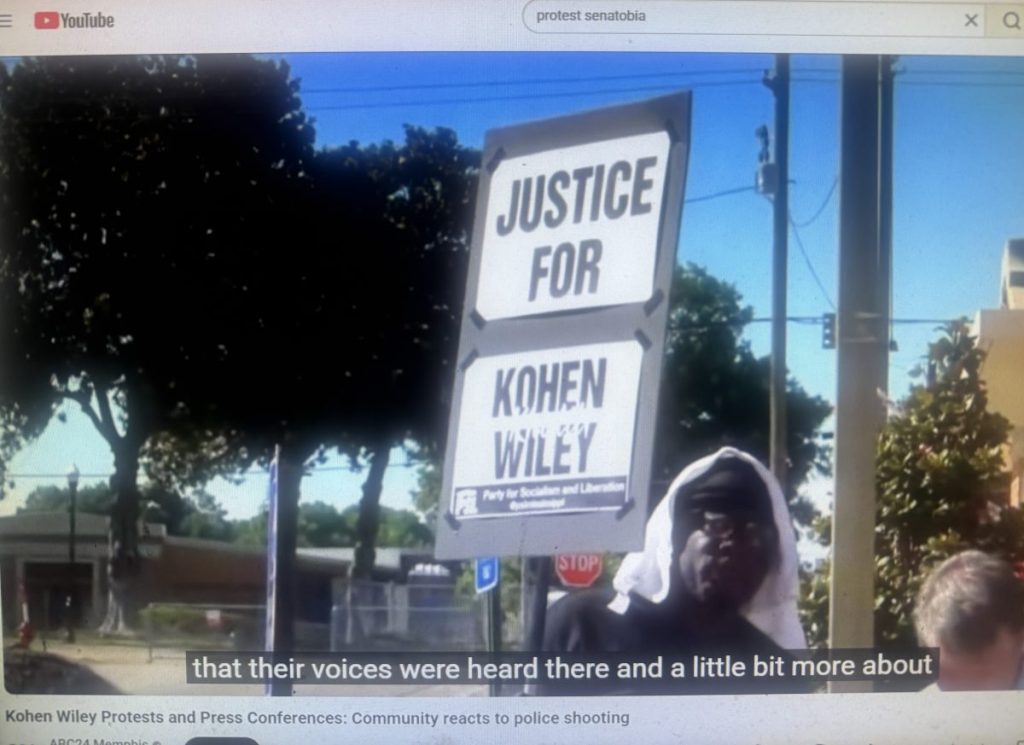
Protester downtown Senatobia on Tuesday, June 16, 2026 holding a sign saying, “Justice for Kohen Wiley. Photo captured from Youtube.
The purpose of this moment should not be division.
The purpose should be dialogue.
The purpose should be transparency.
The purpose should be accountability.
The purpose should be understanding.
If trust has been damaged, now is the time to rebuild it.
Not after the headlines fade.
Not after the cameras leave.
Not after people stop asking questions.
Now.
Because technology may change.
Corporations may change.
Governments may change.
But one principle remains constant.
The people still have a right to know.
And perhaps the most important question of all is this:
Who is watching the people who are doing the watching?
That, dear reader, is The Southern Truth.



Great article. Truth Spoken. Love it. Continue to Enlighten all.
Well written we are comcerned regarding our community. We need answers and meamingful dialogue