Parent Action Coalition for Education (PACE) Attends EdVoice Breakout Session to Support Reading Literacy at Ethnic Media Conference
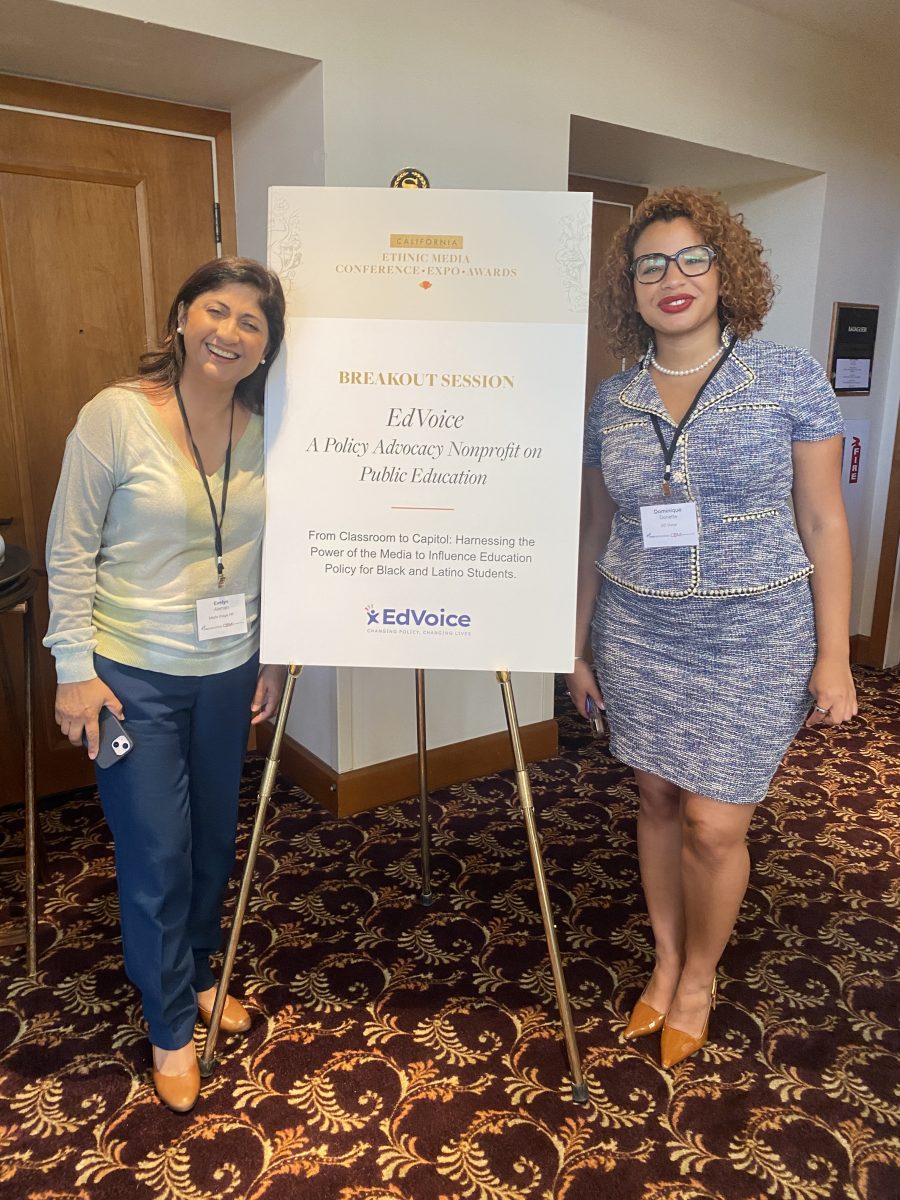
Evelyn Aleman and Dominique Donette at EdVoice Breakout Session at the Ethnic Media conference. Photo by Gloria Zuurveen .
By Gloria Zuurveen, Editor-in-Chief
As the Founder & CEO of Parent Action Coalition for Education (PACE), a 501 (c) (3) nonprofit organization whose mission is to advocate on behalf of youth and young adults for educational literacy and to break the cycle of illiteracy with parental involvement, I chose to participate in the Breakout Session of EdVoice because it has critical information to help stop the pattern of illiteracy when it comes to public policies. EdVoice was front and center with Dominique Donette, Director of Government Affairs, leading the charge and she is calling an alarm about how illiteracy is causing our children great harm.
With a panel of educational advocates, Donette was on her job. She introduced the panel one by one:
Darryl White, Sr., Chair, Black Parallel School Board
Heather Calomese, Chief Policy & Advocacy Officer, EdVoice Institute
Carlos Marquez, III, Board Member, Sacramento Literacy Foundation
Shianne Smith, Director of Communications, Innovate Public Schools
Evelyn Aleman, President of Media Image PR and Founder of Our Voice
They were enthused to infuse us with educational information about the critical matter at hand and they were very knowledgeable about policies and politics of the public education landscape. EdVoice Institute is a 501(c)(3) too, and its mission is reshaping public education in California so that students from low-income communities have futures filled with opportunity. This nonprofit education advocacy organization influences critical policy changes at the state level to improve academic outcomes and opportunities for all children.
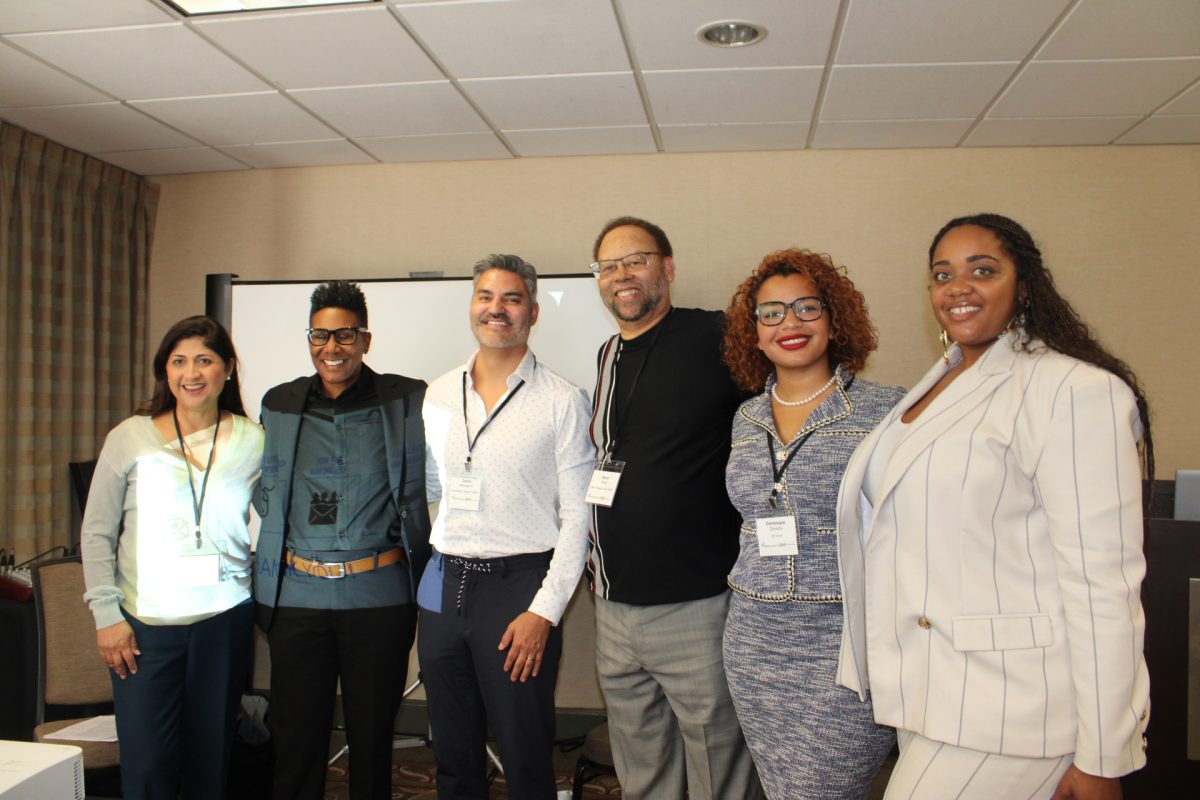
left to right) Evelyn Aleman, Heather Calomese, Carlos Marquez, III, Darryl White, Sr., Dominique Donette and Shianne Smith pose for picture after an educational panel during the Ethnic Media Conference. Photo by Gloria Zuurveen
The Current State of Educational Achievement
When one looks at the current state of educational achievement, across the board, California ranks at or below the national average on student achievement and has amongst the highest achievement gaps of any state between low-income and higher-income students. Looking at the overall ELA Proficiency Rates, it is 35% for low-income students and 66% for higher-income students. Overall math proficiency rates are 23% for low-income students and 54% for higher-income students. College-Readiness rates are 37% for low-income students compared to 66% for higher-income students. That’s a big difference, no matter how you look at it, and this is why this workshop was so crucial for me to attend to stay abreast of education and to know what is necessary when it comes to public policy and illiteracy.
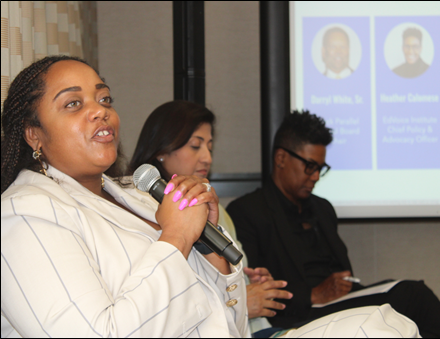
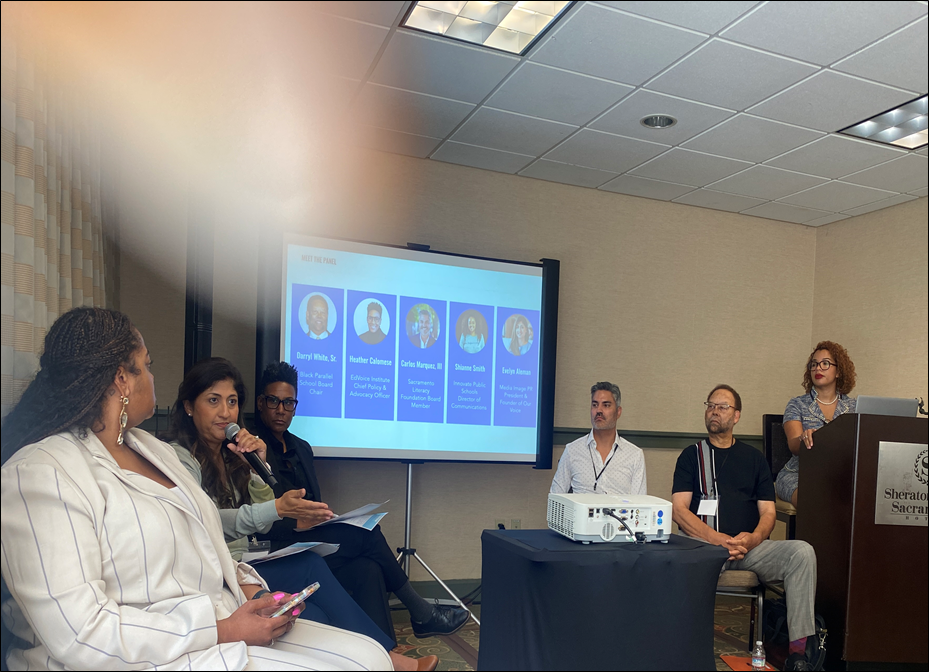
Pictured above: Shianne Smith speaking during EdVoice Breakout session at the Ethnic Media Conference in Sacramento recently. (below)Evelyn Aleman speaking at the conference about the importance of media when it comes to getting the word out about educational issues and public policies. Photo by Gloria Zuurveen
The Widening Gap
Why is the gap so wide? According to EdVoice, we have two unequal Californias. It reports that every child has the right to a high-quality education that prepares them for future college and career opportunities, but the unfortunate reality is that ZIP code and income still often define educational experiences in California. On every meaningful measure of academic performance and college readiness, children from low-income communities– who are disproportionately Black and Latino–fare far worse than their higher-income peers. This is not a matter of ability, it’s a matter of access to the quality education and supplemental supports readily available to higher-income students.
As the fourth-largest economy in the world, it is unacceptable that California isn’t prioritizing scalable solutions and adequate resources to solve this social justice issue. For this reason, EdVoice is credited with recent policy priority successes, such as how they’ve been able to elevate the importance of universal screening for reading difficulties, which influenced the passage of SB 114 requiring screenings in all K-2 students. Currently, they are supporting the implementation phase.
EdVoice has also established the CA Early Literacy Coalition and published a policy brief influencing the early literacy reform bill AB 2222 (Rubio). But that’s not all. EdVoice has provided information used by partners to help ensure the Golden State Teacher Grant program focused only on high-needs schools (2023) and advocated to prevent $60 million cuts to the program (2024).
Last but not least, EdVoice has created a diverse coalition to address the shortage of diverse, quality educators in high-needs schools. They are seeking you too to join the movement. Visit them at edvoiceinstitute.org.