Water Is Not Optional: Why Inglewood’s Utility Rates Are Rising—and What the Law Requires
THE SOUTHERN TRUTH
Hard News | Public Utilities | Civic Education
 By Dr. Gloria Zuurveen, Editor-in-Chief, PACE NEWS
INGLEWOOD—When water rates increase, the first question residents ask is why. The second is who caused it. And the third—often unspoken—is do we have a choice?The answer to the last question is simple and sobering: no.
On Tuesday, December 16, 2025, at 2:00 p.m., the Inglewood City Council will hold a public hearing on proposed water, sewer, and recycled water service rate increases, in compliance with Article XIII D of the California Constitution and Proposition 218. Property owners may submit written protests, which will be counted under strict legal rules. But regardless of emotion, opposition, or frustration, the City of Inglewood cannot legally provide water service without charging rates sufficient to cover the cost of service. That is not politics. That is constitutional law.
Why Public Notices Matter—and Why PACE NEWS Publishes Them
Public notices are not advertisements. They are legal instruments of democracy. They exist so that residents—especially homeowners and taxpayers—have:
-
- Advance notice of proposed government action
- Clear information about hearings, increases, and taxes
- A lawful opportunity to object, protest, or participate
- A voice and a choice before decisions are finalized
That is why this water-rate hearing was published in PACE NEWS, a legally adjudicated newspaper of general circulation, distributed weekly throughout the City of Inglewood and Los Angeles County.
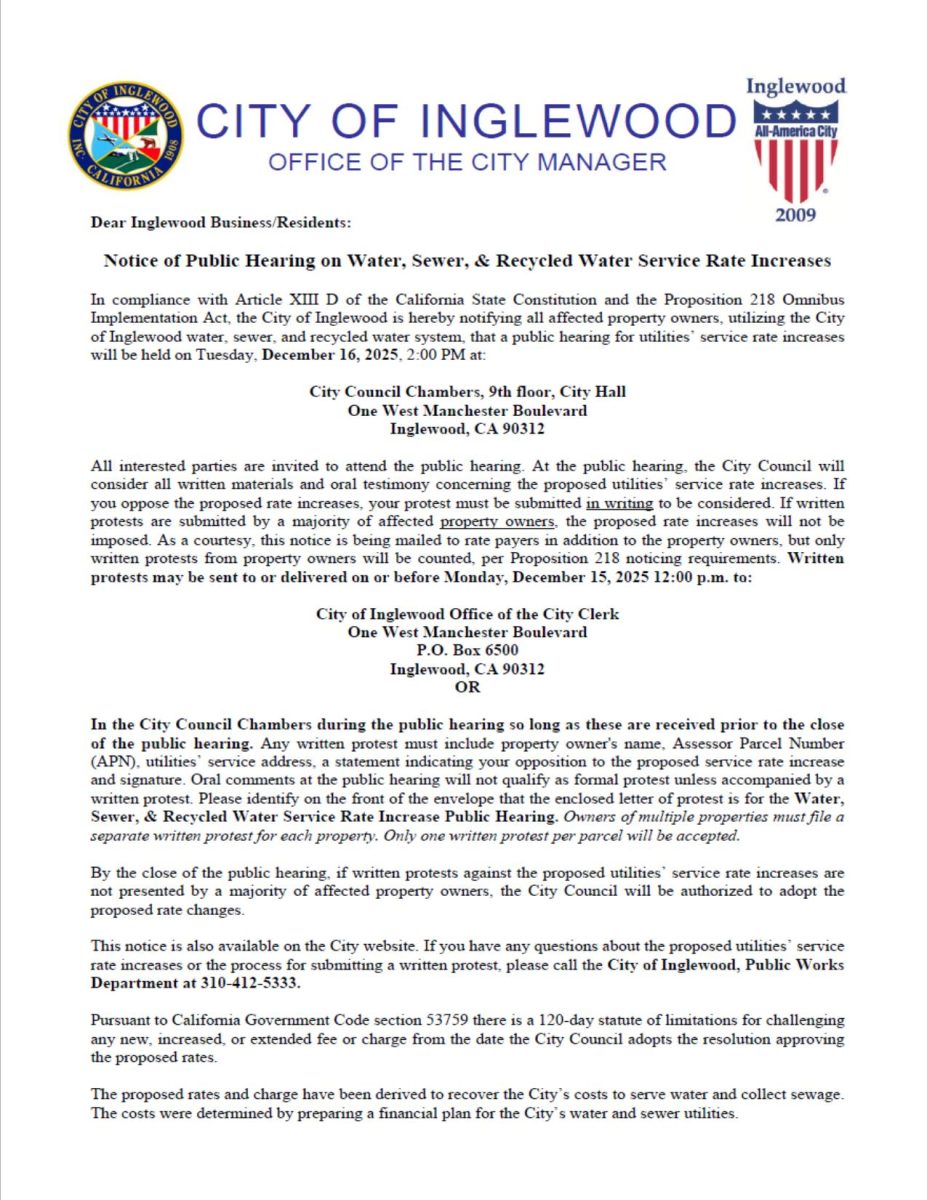
PACE NEWS meets the statutory requirements for public notice publication because:
- It is adjudicated by the court
- It has established, paid circulation
- It serves a broad geographic area
- It provides consistent, verifiable notice to the public
Democracy does not work if notices are hidden, missed, or ignored.
Democracy works when the people are informed—and then allowed to respond.
This public hearing notice was published so residents could know, prepare, and decide how to act—whether that means submitting a written protest, attending the hearing, or conserving water to manage future bills.
How Inglewood Gets Its Water
Inglewood does not control wholesale water prices. The City’s potable water supply is derived from:
- 77% purchased through the West Basin Municipal Water District (WBMWD), which in turn purchases water from the Metropolitan Water District (MWD)
- 23% from City-owned groundwater wells, which still require treatment, electricity, staffing, and ongoing maintenance
The City’s water distribution system—approximately 150 miles of pipeline—was largely constructed between 1930 and 1960. Aging infrastructure alone requires continuous reinvestment simply to keep water flowing safely.
Why Rates Are Increasing Now
According to the City’s public notice and financial analysis:
- Wholesale water purchase rates increased 12% on January 1, 2025
- An additional 10% wholesale increase was anticipated for January 1, 2026, adding approximately $2.7 million in water purchase costs
- Recycled water rates increased 11.3% effective July 1, 2025, with another 10% increase planned for July 1, 2026, adding roughly $350,000 annually
- Water rates were last updated in October 2023
- Sewer rates were last adjusted in March 2012
Without the proposed increases:
- The City’s water fund is projected to be in deficit by Fall 2026
- Sewer reserves are expected to be exhausted by the end of 2026
Under California law, utility rates must reflect the actual cost of service. The City cannot legally subsidize water or sewer operations using general funds.
Historical Context: Why Trust Is Thin
Many residents are asking hard questions—and rightfully so—because regional water agencies have a long and documented history of governance scandals.
One such example frequently cited in public discussion is an article published by the Signal Tribune on September 5, 2014, written by Sean Belk, which detailed felony corruption charges involving elected water-agency officials and alleged misappropriation of public funds. That article contributed to long-standing public concern about how water agencies are governed and how ratepayer money is protected.
That reporting is more than a decade old, but its legacy remains relevant—not as a current legal proceeding, but as background that explains why residents are skeptical when wholesale water costs rise.
The Southern Truth is this:
- When mismanagement or corruption occurs at the regional level, cities do not escape the financial consequences.
- Wholesale water agencies recover costs through rate structures.
- Cities are legally required to pay those costs.
- Residents ultimately see the impact on their utility bills.
History does not set today’s rates—but it explains today’s distrust.
What the City Council Can—and Cannot—Do
Mayor James T. Butts Jr. and the City Council—
- Gloria Gray (1st District)
- Alex Padilla (2nd District)
- Eloy Morales (3rd District)
- Dionne Faulk (4th District)
—will hear community input and consider written protests. Some residents question leadership overlap in regional water governance; others see value in representation where wholesale decisions are made. But regardless of opinion, the Council cannot vote away state constitutional requirements. They are deciding whether Inglewood will:
- Maintain water and sewer service
- Preserve fire-flow capacity and public safety
- Keep utility funds solvent and legally compliant
What Proposition 218 Allows Residents to Do
Property owners may submit written protests that:
- Include the owner’s name, APN, service address, statement of opposition, and signature
- Are submitted by the deadline or before the close of the public hearing
- Are filed separately for each parcel owned
If a majority of affected property owners submit valid written protests, the increases cannot be imposed. Oral comments alone do not count as formal protests.
The Practical Southern Truth
- Water is not optional.
- Sewer service is not optional.
- Fire protection tied to water infrastructure is not optional.
If residents want to reduce the impact on their household budgets, the only guaranteed tool is conservation:
- Use less water
- Stay within lower usage tiers
- Fix leaks
- Be intentional with consumption
The Bottom Line
Inglewood is growing. Construction cranes are up. Global events, stadiums, housing, and commerce are expanding. None of it works without water.
The Southern Truth is plain:
If a city wants water tomorrow, it must pay for it today—even when history has made trust harder and bills heavier.
- Hold leaders accountable.
- Know your rights.
- Submit your protest if you choose.
But understand the law—and the reality—before you turn on the tap.
TST